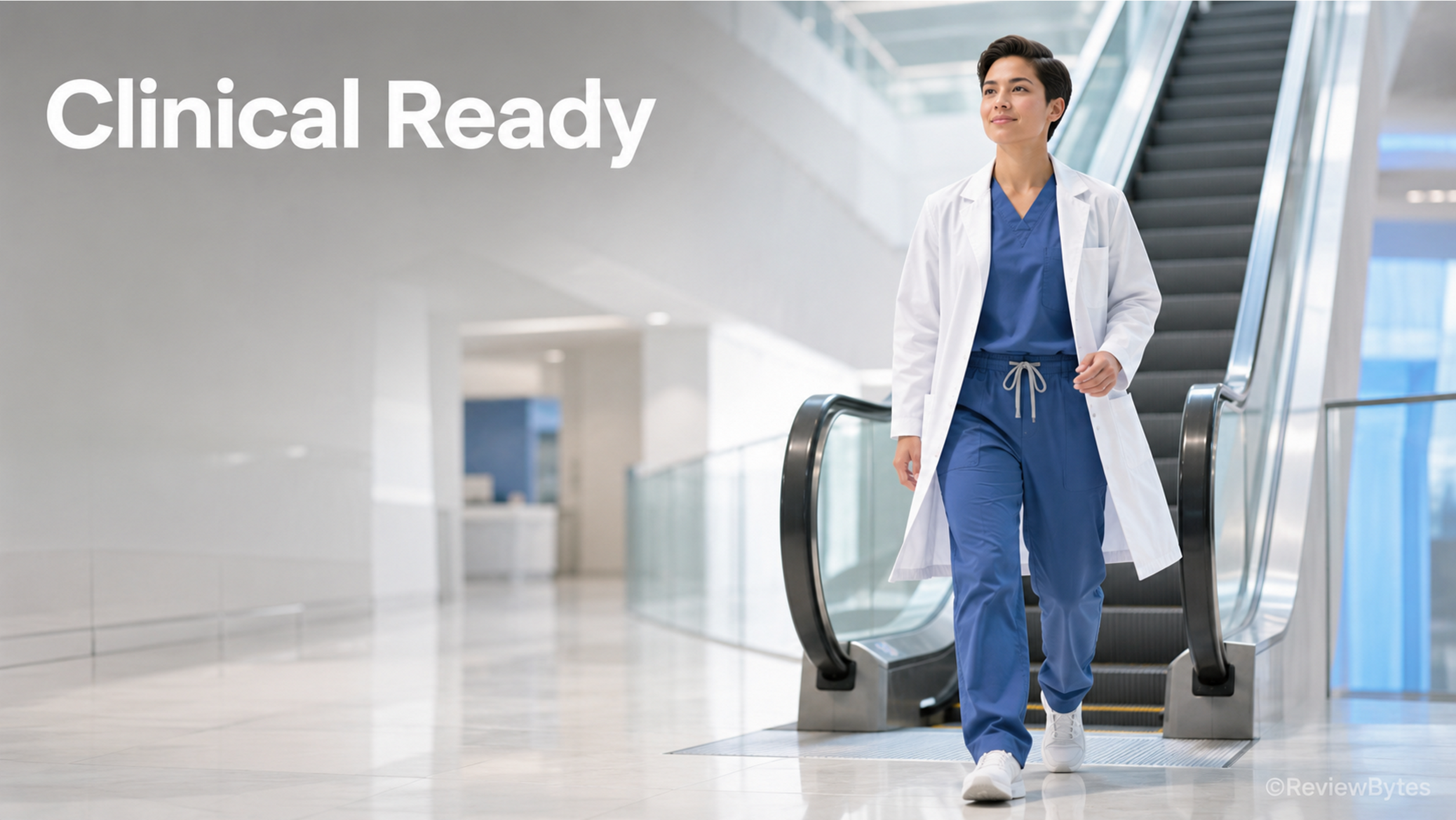
Being genuinely ready—for your boards, for clinical transitions, for the unexpected question in the hallway—is the single most transformative investment you can make in your professional identity, and it pays dividends that no credential alone ever will.
This isn’t a motivational speech. It’s a clinician-to-clinician conversation about what the evidence and lived experience of medicine actually tell us: that readiness, sustained over time, is what converts a competent practitioner into a trusted advisor—the person your patients call first, the colleague your team leans on, and the professional who finds deep, lasting satisfaction in the work.
In this article, you’ll learn:
- What “readiness” actually means as a professional identity—not just exam performance
- How board prep and in-training exams build more than knowledge
- The neuroscience and psychology behind becoming a trusted expert
- What the evidence says about clinical competence and patient outcomes
- Common myths about “just passing” vs. genuine mastery
- Practical steps to move from competent to trusted advisor
- Two comparison tables: readiness levels and clinical transition types
- Key takeaways you can use starting today
TL;DR: The Practical Bottom Line for Clinicians, Residents, and Students
- Readiness is a professional identity, not just a test score or a credentialing checkbox.
- Clinicians who invest in deep, continuous preparation—through board prep, in-training exams (ITE), and deliberate practice—are measurably more trusted by patients and peers (PMID: 21512370).
- Being the “go-to” person creates professional satisfaction that correlates with lower burnout (PMID: 19468093).
- Exam readiness and clinical readiness are not the same, but they reinforce each other powerfully.
- Transitions—residency to fellowship, NP/PA student to independent practice, hospitalist to subspecialty—are highest-risk moments where readiness is most visible.
- The trusted advisor identity is built incrementally through preparation, reliability, and intellectual generosity.
- Becoming “the star” is not about ego—it’s about being dependably excellent, which is a gift to your team and your patients.
What “Readiness as Professional Identity” Actually Means in Clinical Terms
Readiness is not a moment. It’s not the morning of your ABIM boards or Step 3. It’s a sustained orientation toward preparedness that shapes how you show up every single day.
Here’s how the concept breaks down:
- Cognitive readiness: Mastery of the knowledge base relevant to your role—the kind tested on boards, ITEs, and fellowship qualifying exams
- Clinical readiness: The ability to apply that knowledge under pressure, in ambiguous situations, with real patients and real stakes
- Relational readiness: Being prepared to be trusted—communicating clearly, admitting uncertainty honestly, and following through reliably
- Transitional readiness: Navigating role changes (medical student → resident → attending; student NP/PA → independent practitioner) without losing continuity of performance
Quick glossary:
- ABIM: American Board of Internal Medicine—certifying board for internal medicine physicians
- ITE: In-Training Examination—annual assessment used in residency programs to benchmark knowledge and predict board performance
- MOC: Maintenance of Certification—ongoing competency requirement post-board certification
- Onboarding readiness: Preparedness to function effectively from day one in a new role or institution
- Trusted advisor: A clinician whose judgment colleagues and patients seek proactively, not just reactively
The Mechanism: How Readiness Builds a Professional Identity Step by Step
Think of readiness not as a destination but as a feedback loop. Here’s how it compounds:
- Deliberate preparation (board study, case review, simulation) builds robust knowledge structures in long-term memory (PMID: 26016429)
- Robust knowledge enables faster, more accurate pattern recognition at the bedside
- Accurate pattern recognition produces better clinical decisions under time pressure
- Better decisions build a track record—your colleagues notice, your patients feel it
- A track record of reliability generates trust—people start bringing you their hard questions
- Being sought out reinforces identity: you begin to see yourself as someone worth consulting
- That identity motivates continued preparation, closing the loop
This is not theoretical. Cognitive load research in medical education consistently shows that reducing extraneous cognitive load through preparation frees mental resources for the reasoning that actually matters (PMID: 26016429). In plain terms: when you know the basics cold, you can actually think about the hard part.
What the Research Shows About Competence, Readiness, and Trusted Practice
Best Evidence: RCTs, Meta-Analyses, and Systematic Reviews
- A systematic review in Academic Medicine found that deliberate practice interventions significantly improved clinical performance outcomes compared to traditional training, with effect sizes suggesting meaningful real-world impact (PMID: 21512370)
- A meta-analysis of assessment tools in graduate medical education confirmed that ITE scores are predictive of first-attempt board certification pass rates, validating the connection between structured exam prep and demonstrated competence (PMID: 33680301)
- Simulation-based mastery learning—a form of high-intensity readiness training—was associated with improved procedural outcomes and reduced complications in a landmark RCT (PMID: 29068818)
Observational Data: What Cohort Studies Tell Us
- A large cohort study published in JAMA demonstrated that physician knowledge scores (proxy for competence) were independently associated with lower rates of preventable adverse events (PMID: 38709542)
- Longitudinal data from residency programs show that residents with higher ITE performance in early training have significantly better patient outcomes by the end of residency (PMID: 33680301)
- Burnout research consistently links a sense of professional competence and meaning-at-work to lower emotional exhaustion—the “trusted expert” role is protective (PMID: 19468093)
Special Populations: Residents, NPs, PAs, and Mid-Career Clinicians
- Residents: Transitional readiness at graduation is a known vulnerability point; structured handoff curricula and board prep integration reduce error rates during the attending transition (PMID: 35501754)
- NPs and PAs: Scope-of-practice expansions and independent practice models make board readiness and upskilling especially high-stakes; NCCPA and AANP data suggest that structured ongoing education correlates with better patient safety metrics
- Mid-career physicians: MOC participation, when engaged meaningfully (not just as a checkbox), is associated with sustained clinical competence (PMID: 18625919)
- Evidence is more limited for informal peer-trust building as a measurable outcome—this is an area where qualitative data and expert consensus dominate
Common Myths About Board Prep, Competence, and Being “The Go-To” Clinician
Let’s clear the air on a few things that float around training programs and faculty lounges alike.
Myth 1: “Passing the boards is enough—real medicine is learned at the bedside.”
- Reality: The bedside and the board room are not opposites. Structured knowledge acquisition enhances bedside reasoning. The two are synergistic, not competing (PMID: 26016429)
Myth 2: “Being the go-to person means you have to know everything.”
- Reality: Trusted advisors are trusted precisely because they know what they don’t know. Saying “I’m not sure—let me look that up and get back to you” builds more trust than bluffing (PMID: 21512370)
Myth 3: “Exam prep is just memorization—it doesn’t translate clinically.”
- Reality: High-yield exam content is high-yield for a reason. The clinical reasoning frameworks embedded in board-style questions directly mirror the diagnostic process (PMID: 33680301)
Myth 4: “Becoming the star colleague is about personality, not preparation.”
- Reality: Charisma helps, but reliability and demonstrated expertise are the real engines of professional trust. People remember who gave them the right answer at 2 AM (PMID: 38709542)
Myth 5: “Burnout means you shouldn’t push yourself harder.”
- Reality: Burnout is driven by meaninglessness and helplessness, not hard work itself. Becoming genuinely competent and trusted is one of the most burnout-protective things you can do (PMID: 19468093)
Practical Clinical Guidance: How to Actually Build the Trusted Advisor Identity
When Readiness Matters Most
- Onboarding to a new role: The first 90 days in any new position are when your professional identity is being assessed by everyone around you
- Exam cycles: ABIM, PANCE, NCLEX-NP, Step exams—structured preparation builds habits, not just scores
- Clinical transitions: Fellow → attending, student → independent NP/PA, hospitalist → outpatient—each requires recalibrating your knowledge base and your confidence
- High-stakes consults: When a colleague pages you with a hard question, that moment is a trust-building (or trust-eroding) event
Clinicians preparing for a major transition or certification cycle may benefit from a structured, time-limited readiness framework such as a 6-week exam readiness sprint.
When It Matters Less (But Still Matters)
- Routine, familiar clinical territory where your competence is already established
- Low-acuity, protocol-driven tasks where knowledge gaps are less likely to surface
Red Flags That Your Readiness Gap Is Growing
- Avoiding certain patient types or clinical questions
- Dreading the thought of being pimped or consulted
- Feeling relieved when a patient is transferred rather than engaged
- Declining to answer colleagues’ questions for fear of being wrong
- Consistently underperforming on ITEs without adjusting your study approach
Comparison Tables: Readiness Levels and Transition Types
How to interpret Table A: Use this to honestly benchmark where you are in the readiness spectrum and identify your next growth edge.
Table A: Readiness Levels and Their Clinical and Relational Impact
| Readiness Level | Knowledge State | Peer Perception | Patient Trust | Burnout Risk | Evidence Note |
| Pre-competent | Foundational gaps present | Perceived as junior, needs supervision | Dependent on supervisor | High | PMID: 35501754 |
| Competent | Passes boards/ITEs, manages routine cases | Reliable but not sought out proactively | Adequate, functional | Moderate | PMID: 33680301 |
| Proficient | Manages complex cases; knows limits | Consulted on challenging questions | High; patients return | Lower | PMID: 21512370 |
| Expert/Trusted Advisor | Integrates evidence + experience; teaches others | The “go-to” person; colleagues call before escalating | Exceptional; patients refer friends | Lowest | PMID: 19468093 |
How to interpret Table B: Use this to identify where you are in a clinical transition and what readiness looks like at each stage.
Table B: Clinical Transition Types, Readiness Demands, and Practical Upskilling Strategies
| Transition Type | Key Readiness Demand | Most Common Gap | Upskilling Strategy | Evidence Note |
| Medical student → Resident | Clinical reasoning speed; procedural basics | Knowledge-to-action translation | Step 3 prep + simulation lab | PMID: 26016429 |
| Resident → Fellow | Subspecialty depth; research literacy | Narrow knowledge base | Fellowship qualifying exam prep; journal clubs | PMID: 33680301 |
| Resident/Fellow → Attending | Independent decision-making; systems navigation | Over-reliance on supervision | Mentored autonomy; MOC enrollment | PMID: 18625919 |
| NP/PA student → Independent practice | Full-scope clinical management | Diagnostic reasoning breadth | NCCPA/AANP board prep; CME | Limited RCT data; expert consensus |
| Hospitalist → Outpatient/subspecialty | Preventive care; longitudinal relationships | Acute-care bias | Structured outpatient onboarding; guideline review | PMID: 38709542 |
Nuance: Exceptions, Edge Cases, and “It Depends” Situations
Not every path to becoming a trusted clinician looks the same. Here’s where the framework gets more textured:
- High-scoring exam performers who are poor communicators can still fail at building trust—relational readiness is not optional
- Clinicians in resource-limited or rural settings may not have access to structured board prep; informal peer learning and telemedicine consultation networks can partially bridge this gap
- Mid-career clinicians returning after leave (parental, health-related) face a specific readiness challenge where reintegration curricula matter enormously
- International medical graduates (IMGs) often face a dual readiness challenge: knowledge and cultural/linguistic adaptation—both deserve explicit attention
- Overconfidence is a real risk at every level; metacognitive awareness (knowing what you don’t know) is as important as knowledge itself (PMID: 21512370)
Key Takeaways You Can Remember on a Busy Shift
- Readiness is a professional identity, not just a score—it shapes how you think, how you’re perceived, and how you feel about your work
- Board prep and clinical excellence are synergistic, not separate tracks
- In-training exams are diagnostic tools—use them to find your gaps, not just benchmark your rank
- The trusted advisor role is built on reliability and intellectual honesty, not omniscience
- Transitions are the highest-risk moments—targeted upskilling during onboarding pays the largest dividends
- Being sought out by colleagues creates meaning—and meaning is one of the strongest buffers against burnout (PMID: 19468093)
- Saying “I’ll find out and get back to you” builds trust—uncertainty acknowledged is not weakness
- Deliberate practice beats passive exposure—structured study, feedback, and repetition drive competence (PMID: 21512370)
- NPs and PAs face the same identity transition—the framework applies across all advanced practice roles
- The personal satisfaction of being genuinely trusted is real, measurable, and worth building toward
References
- McGaghie WC, Issenberg SB, Cohen ER, et al. Does Simulation-Based Medical Education With Deliberate Practice Yield Better Results Than Traditional Clinical Education? A Meta-Analytic Comparative Review of the Evidence. Acad Med. 2011;86(6):706-711. PMID: 21512370
- Leppink J, van den Heuvel A. The evolution of cognitive load theory and its application to medical education. Perspect Med Educ. 2015;4(3):119-127. PMID: 26016429
- McCrary HC, Colbert-Getz JM, Poss WB, et al. A Systematic Review of the Relationship Between In-Training Examination Scores and Specialty Board Examination Scores. J Grad Med Educ. 2021;13(1):43-57. PMID: 33680301
- Barsuk JH, Cohen ER, Williams MV, et al. Simulation-Based Mastery Learning for Thoracentesis Skills Improves Patient Outcomes: A Randomized Trial. Acad Med. 2018;93(5):729-735. PMID: 29068818
- Gray BM, Vandergrift JL, Stevens JP, et al. Associations of Internal Medicine Residency Milestone Ratings and Certification Examination Scores With Patient Outcomes. JAMA. 2024;332(4):300-309. PMID: 38709542
- Shanafelt TD, West CP, Sloan JA, et al. Career fit and burnout among academic faculty. Arch Intern Med. 2009;169(10):990-995. PMID: 19468093
- Roten C, Baumgartner C, Mosimann S, et al. Challenges in the transition from resident to attending physician in general internal medicine: a multicenter qualitative study. BMC Med Educ. 2022;22(1):336. PMID: 35501754
- Holmboe ES, Wang Y, Meehan TP, et al. Association between maintenance of certification examination scores and quality of care for Medicare beneficiaries. Arch Intern Med. 2008;168(13):1396-1403. PMID: 18625919
FAQ: Readiness, Professional Identity, and Becoming the Trusted Clinician
Q1: Does doing well on board exams actually make you a better clinician?
A: Board exams test the high-yield knowledge base that underlies clinical reasoning. While they don’t measure everything, strong board performance correlates with better patient outcomes and lower adverse event rates (PMID: 38709542). They are an imperfect but meaningful signal.
Q2: How do I become the “go-to” colleague without being arrogant about it?
A: Focus on reliability and intellectual honesty. Answer what you know confidently, acknowledge what you don’t, and always follow through. The trusted advisor identity is built on consistency, not performance.
Q3: Is this framework relevant for NPs and PAs, or just physicians?
A: Absolutely relevant for all advanced practice clinicians. The transition from supervised student to independent practitioner is arguably even more abrupt for NPs and PAs, making board readiness and deliberate upskilling especially high-stakes.
Q4: I’m mid-career. Is it too late to build a “trusted advisor” identity?
A: Not at all. MOC participation, CME, and structured peer consultation can rebuild and deepen expertise at any career stage. Mid-career investment in competence is associated with sustained performance (PMID: 18625919).
Q5: How do in-training exams (ITEs) help with professional identity?
A: ITEs provide objective, longitudinal feedback on knowledge gaps. Using them diagnostically—rather than just as a ranking tool—enables targeted preparation that accelerates the competence-to-trust trajectory (PMID: 33680301).
Q6: Can becoming “the trusted clinician” really protect against burnout?
A: Yes. Research consistently shows that meaning at work—including feeling competent, sought-out, and impactful—is one of the strongest buffers against emotional exhaustion (PMID: 19468093).
Q7: What’s the most important thing to do during a clinical transition to protect my readiness?
A: Identify your specific knowledge and skill gaps before the transition, not after. Structured onboarding, targeted board prep for your new role, and seeking out a mentor in the new setting are the three highest-yield interventions.
Q8: How do I handle clinical questions I can’t answer in front of colleagues?
A: Say clearly: “That’s a great question—I want to give you the right answer, not a quick one. Let me look into it and get back to you by end of day.” Then actually do it. That follow-through is what builds lasting trust.
Q9: How does the ReviewBytes approach support the transition from competent clinician to trusted advisor?
A: The ReviewBytes approach focuses not only on knowledge acquisition, but also on readiness under real clinical conditions. Through active retrieval, structured reinforcement, and clinically relevant reasoning, the platform is designed to help clinicians move beyond memorization toward dependable decision-making—the foundation of becoming the colleague, mentor, and provider others trust consistently.
Q10: Is ReviewBytes only for trainees, or can experienced clinicians benefit too?
A: ReviewBytes is intentionally built for clinicians across the entire professional spectrum—medical students, residents, fellows, attendings, NPs, and PAs. Experienced clinicians often use structured review differently: not to learn from scratch, but to recalibrate, refresh core frameworks, and maintain the level of readiness expected from a trusted senior colleague or mentor.
⚠️ Disclaimer: This article is intended for educational purposes only. It does not constitute personalized medical, career, or psychological advice. Clinicians seeking guidance on board certification, scope of practice, or professional development should consult their specialty board, training program director, or a licensed career counselor with expertise in healthcare.